SEO consulting means expert guidance that helps businesses improve their search rankings through audits, strategy, and recommendations without hiring a full agency. It identifies technical issues, on-page and off-page recommendations, providing a clear roadmap to increase visibility, attract and convert the right audience, and achieve sustainable organic growth.
Introduction
Many businesses engage with SEO, but not all of them have either the expertise, budget, capacity, or intention to hire a full-time SEO agency to work with them.
That’s where SEO consulting comes in.
Consulting offers you a roadmap, with expert advice from an SEO consultant for your website, audience, and industry to rank higher in search results, convert and attract the right audience.
They uncover hidden issues, identify missed opportunities, and plan strategies that can create real impact.
The best part? All this comes without the pressure of hiring an entire agency or monthly retainers.
In this blog, we cover what SEO consulting is, its benefits, how to choose the right consultant for your business, and what to expect when working with a consultant.
Meaning
SEO consulting is when an external consultant reviews your website, identifies what is stopping it from ranking well, and provides a clear strategy to improve your visibility in search engines. Instead of doing all the work themselves, the consultant guides you or your team on what to fix, why it matters, and how to prioritise improvements.
Think of a consultant as a specialist advisor. They analyse your site’s technical setup, content, and competition, then give practical recommendations to help your business attract the right search traffic.
Example
Imagine a law firm website that receives very little traffic from Google.
A consultant might review the site and discover that:
- Important pages are not indexed
- Search intent is misaligned
- Internal linking is weak
- Technical issues are slowing down the site
The consultant then provides a detailed audit and roadmap explaining what to fix first, what content to create, and how to structure the site for better rankings. Your in-house team can then implement those recommendations.
For many businesses, consulting provides expert guidance without the long-term overhead of hiring a full SEO agency.
Benefits
- Expert insight: Objective guidance from someone who knows what search engines look for.
- Custom strategy: Plans designed around your business, not generic templates.
- Faster fixes: Issues are diagnosed and solved quickly, avoiding wasted effort.
- Cost-effective: Access to expert help without the overhead of a full agency.
- Team empowerment: Your staff learn along the way, building long-term capability.
What do they actually do?
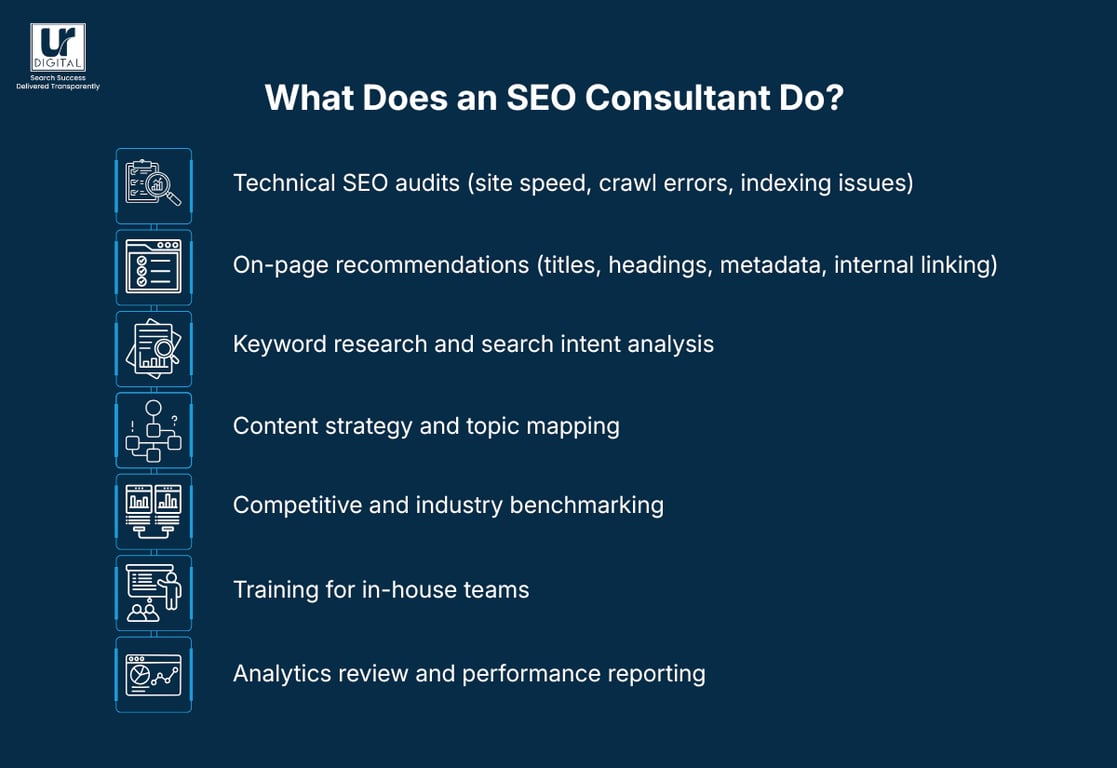
An consultant identifies any problems, sets a clear strategy, and helps in implementing changes that actually bring positive results.
They often perform the following tasks:
When to hire?
If:
- You already have a website but aren’t seeing results in search.
- You want an expert to validate your existing SEO strategy.
- You are planning a site migration or redesign and want an independent review first.
- You don’t have the budget for a full agency but still need specialist guidance.
- You have an in-house SEO team that could benefit from training or direction.
- You are facing an issue which you believe needs an expert oversight.
Pricing
The pricing can vary depending on the scope and complexity of the project. Common models include:
- Hourly rates: Best for small projects, troubleshooting, or advice sessions.
- Project-based fees: For defined tasks like audits, migrations, or strategy documents.
- Monthly retainers: For ongoing advisory, check-ins, and reporting.
Rates depend on the consultant’s experience, the industry they specialise in, and how complex the project is.
Steps to Hire
Focus your efforts on these four practical steps to ensure you choose the right vendor.
1. Budget and desired outcomes
Before you start looking for a consultant, be clear on two things: how much you’re willing to spend and what you want to achieve? Do you want more traffic, better leads, or help fixing technical issues?
Also, decide if you can afford a flat monthly retainer or if you’re comfortable with a project-based fee. This immediately filters candidates.
For the best outcome, create a specific description that includes a specific list of tasks (e.g., such as conducting a technical audit). This ensures you attract a specialist who matches your precise need.
If you are unsure of desired outcomes or need help with what budgets to allocate, there are a few things you can do:
- Ask in your network for recommendations
- Look them up online or in your preferred AI chat
- Question everything, they say. Don’t trust their word, good consultants are always willing to provide clarifications
- Independently vet their reputational claims
- Try to identify if they have your best interests or just want your money
The goal you are trying to achieve is “are they the right fit for your business”. Good consultants generally are quite honest individuals or businesses and will advise realistic budgets and expectations.
2. Ethics and experience
Ask targeted questions to gauge their risk tolerance and communication style.
For example, “Are you currently working with any brands or competitors in my niche?” This addresses potential conflicts of interest up front.
Also, ask them for samples of past work, focusing on the results they’ve achieved for other clients.
3. Asking right questions
Here are some examples of questions you can ask:
- How often do you check in with your clients on how the strategy is working, and what does a typical report include?
- How long does it typically take your consultancy to get meaningful results?
4. Provide the required access
Be prepared to grant immediate, read-only access to your Google Search Console, Google Analytics, and primary auditing tools.
Shameless sales pitch
Now that you know what SEO consulting is, continue reading only if you believe you need one.
This is where we can help.
For over 5 years, we have been redefining the status quo and solving SEO issues big and small. When working with us, our customers usually all have the same issues:
- Not enough time for family as their lead volumes are through the roof
- Revenue numbers that they have not seen for a long time
Our consulting services include:
- One-off sessions
- Monthly retainers
- In-person or online guidance
For more information, check out SEO Consulting Services page.
FAQs
Are SEO consultants worth it?
This is a decision for you to make. But — if you want to grow your online visibility faster and avoid costly mistakes, a consultant is usually worth it. They bring expert knowledge, save you time, and help you avoid trial-and-error. This does not mean that you cannot achieve the same results yourself, they can help you get there faster.
How much do they charge?
SEO consultant rates vary depending on experience, location, and project scope. Some charge an hourly rate (often between $100–$300/hour), while others offer project-based or monthly retainers that can range from $1,000 to $5,000+ per month. UR Digital’s consulting rates start at $349/hr (ex-GST).
What is SEO for a website?
SEO (Search Engine Optimisation) in a website means improving its authority, content, and technical setup so search engines like Google and ChatGPT can easily understand and rank it. It covers things like:
- Technical issues
- On page optimisation
- Off page optimisation including Digital PR
Done right, SEO makes your site more visible in search results and easier for customers to find.
Should I pay someone to do my SEO?
Whilst not a requirement, it’s recommended that you pay someone to do your SEO for better results without experimenting. A professional consultant can uncover issues you may not see, build a strategy aligned with your goals, and guide you on execution so your time and money aren’t wasted.
How to use SEO for beginners?
There are tonnes of online guides, or you can watch our past webinars.
How much does SEO cost?
For most small businesses, ongoing SEO services cost between $3000 and $5,000 per month depending on your industry and goals.
How often should SEO be done?
SEO should be ongoing. At a minimum, you should:
- Audit your site every quarter for technical issues.
- Update or add new content.
- Check rankings and analytics regularly (weekly or monthly) to track progress.
What’s the difference between consulting and coaching?
A consultant provides strategy, audits, and recommendations tailored for your business — sometimes directly managing projects. In contrast, a coach focuses on teaching you or your team how to do SEO, offering support and accountability along the way.
How long does it take to see results?
The timeline varies, depending on factors like competition, site history, and how quickly recommendations are implemented. While some technical fixes can lead to quick improvements, long term results can be seen over 3+ months.